
Italian Culture
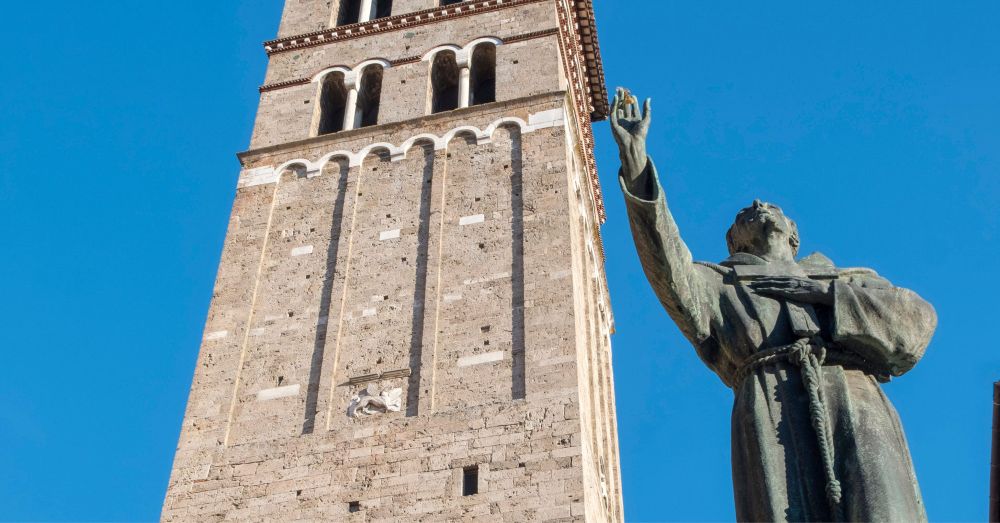
Saint Francis at 800: How Assisi shaped Italy’s faith, language and imagination
Oct
In 2026, Italy and the wider world commemorate 800 years since Saint Francis of Assisi died on 3 October 1226. The anniversary renews attention to a figure who belongs not only to Church history but also to Italy’s cultural history. Francis’s legacy connects Christian practice with language, literature, art and public memory.
In Church history, Francis is remembered as the founder of a movement that sought to renew Christian life through evangelical poverty, fraternity and service. With his early companions, he established the community that became the Order of Friars Minor, or Franciscans. Their example placed humility, peace, hospitality and closeness to people in need at the centre of discipleship. That witness remains relevant in a world still seeking reconciliation, solidarity, care for creation and care for the vulnerable.
Francis’s cultural importance is inseparable from the Canticle of the Creatures, composed principally in 1225 near the end of his life. Written in an Umbrian vernacular rather than Latin, it brought spiritual poetry closer to ordinary listeners. It showed that the language of everyday life could carry theological depth, musical rhythm and emotional force. The Canticle is among the earliest and most influential works in Italian literary history. Its place is foundational, but it should not be overstated: Francis did not create Italian single-handedly. Italian literary culture emerged through a long process involving many regions, dialects, writers and institutions.
The poem’s vision remains powerful. Francis addresses the sun, moon, wind, water, fire and earth as brothers and sisters within a shared household of creation. This language expresses gratitude, humility and responsibility rather than possession. Its verses on forgiveness connect praise with reconciliation, while “Sister Bodily Death” gives the poem a compassionate awareness of mortality. Creation, human relationship and death belong to one spiritual vision, helping explain the Canticle’s continuing meaning across religious and cultural boundaries.
That vision continues to shape Italian culture. Assisi, its basilica and Franciscan traditions preserve a vivid connection to the saint, while the national 800th-anniversary programme places the Canticle at the centre of public commemoration. Artists, musicians, writers and educators have repeatedly adapted Francis’s story, ensuring that his language of peace and fraternity remains part of Italy’s cultural memory.
Giotto’s fresco cycle, traditionally associated with him in the Upper Basilica of Saint Francis in Assisi, narrates episodes from the saint’s life and legacy with striking humanity, movement and emotional clarity. These frescoes helped make Francis’s story visible to generations of pilgrims and visitors and, together with works by Cimabue, Pietro Lorenzetti and Simone Martini, made Assisi a landmark in Italian and European art.
The Via di Francesco, or Way of Saint Francis, remains popular with pilgrims and cultural travellers. It connects Franciscan places and landscapes with Assisi. It can be experienced as a walking journey through medieval towns, churches, hermitages and works of art, with approaches from Tuscany and Romagna and onward journeys from Assisi towards Rome. It is a living cultural and spiritual route, not merely a historical trail.
Cinema has also carried Francis’s story across borders. Franco Zeffirelli’s Brother Sun, Sister Moon (Fratello sole, sorella luna, 1972) is a lyrical, idealised cultural interpretation rather than a documentary. Its poetic style, shaped by the era’s language of simplicity, peace and freedom, helped introduce Francis to an international cinema audience.
Thousands of books have been written about Saint Francis throughout the centuries, highlighting the many aspects of his legacy. Recently, Alessandro Barbero’s historical study “San Francesco” (Laterza, 2025) has become a bestseller in Italy, alongside nationally and internationally acclaimed fiction novels. Drawing on early sources, Barbero revisits the historical Francis beyond familiar devotional images. According to publisher information, Profile Books in the United Kingdom and Pegasus Books in the United States are publishing or making English-language editions or translations available, with Princeton University Press holding world English rights.
Saint Francis is not only a patron saint of Italy, alongside Saint Catherine of Siena, but also one of Europe’s patron saints. This reflects the wider European reach of his message of peace, fraternity and care for creation.
Under Italian Law No. 151 of 8 October 2025, 4 October became a national public holiday in Italy in honour of Saint Francis, beginning in 2026, the 800th anniversary year of his death. This new public holiday highlights Francis’s continuing importance in Italian history, culture, public memory and civic identity.
To conclude, eight centuries after his death, Francis remains a central figure in Christian memory and an essential voice in Italy’s cultural inheritance: a saint whose words helped make vernacular Italian a vehicle for poetry, praise and shared humanity.An old photograph or time spent listening can become a meaningful way to say: grazie, nonna e nonno! These small gestures honour the care, knowledge and cultural continuity that grandparents often bring to family and community life.
References
- Academic and scholarly references
- Benedict XVI, “General Audience,” 27 January 2010. Discussion of Francis’s birth at the end of 1181 or the beginning of 1182. https://www.vatican.va/content/benedict-xvi/en/audiences/2010/documents/hf_ben-xvi_aud_20100127.html
- Società Internazionale di Studi Francescani, publication information on the Canticle as a foundational vernacular Italian literary text. https://www.sisf-assisi.it/elenco-delle-pubblicazioni-della-sisf.php?idC=15
- Jacques Le Goff, Saint Francis of Assisi. Scholarly book; publication details vary by edition.
- Paul Sabatier, Vie de Saint François d’Assise (1894). A classic historical biography whose interpretations should be read in light of later scholarship.
- Barbero, Alessandro. San Francesco. Laterza, 2025. A modern historical study based on early sources. Publisher information notes English-language publication or rights through Profile Books in the United Kingdom, Pegasus Books in the United States, and Princeton University Press for world English rights. https://www.laterza.it/book/?isbn=9788858155325
- Zeffirelli, Franco, director. Brother Sun, Sister Moon (Fratello sole, sorella luna). 1972. https://www.paramountpictures.com/movies/brother-sun-sister-moon
- Assisi / San Francesco organisation and institutional references
- Italian Republic, Law No. 151 of 8 October 2025, establishing 4 October as a national public holiday in honour of Saint Francis. Normattiva: https://www.normattiva.it/eli/id/2025/10/10/25G00153/CONSOLIDATED/20260730
- San Francesco organisation, “Vita di San Francesco.” Online biographical timeline, accessed for this document. https://vita.sanfrancesco.org/en
- San Francesco organisation, “800 anni del Cantico delle Creature.” Online article on the Canticle’s 1225 composition and literary significance, accessed for this document. https://smtp3.sanfrancesco.org/notizie/francescanesimo/800-anni-del-cantico-delle-creature-53605
- Italian Ministry of Culture, National Committee for the Eighth Centenary of the Death of Saint Francis, “Il Cantico delle creature.” Institutional online project, accessed for this document. https://sanfrancesco800.cultura.gov.it/?project=il-cantico-delle-creature
- UNESCO World Heritage Centre, “Assisi, the Basilica of San Francesco and Other Franciscan Sites.” https://whc.unesco.org/en/list/990
- La Via di Francesco / Umbria Tourism, “The St Francis’ Way.” https://www.viadifrancesco.it/en/home
- La Via di Francesco / Umbria Tourism, “St Francis Way in Umbria: from Florence/Rimini to Assisi.” https://www.viadifrancesco.it/en/w/st-francis-way-in-umbria-from-florence-rimini-to-assisi
- La Via di Francesco / Umbria Tourism, “St Francis Way in Umbria: from Assisi to Rome.” https://www.viadifrancesco.it/en/w/st-francis-way-in-umbria-from-assisi-to-romeItalian Ministry of Education, Veneto Regional School Office. “2 ottobre – Festa Nazionale dei Nonni.” 17 September 2021. https://istruzioneveneto.gov.it/20210917_12934/